
We have seen Oklahoma hail chew through weak roofing fast. For churches, the right call is simple: match the roofing system to the roof section, the storm risk, and how long the building needs to serve. For steep sanctuary roofs, standing seam metal is usually the long-term pick. For flat sections, TPO, PVC, or modified bitumen often fit better.
Our Take: We have worked on church roofs across the Oklahoma City metro for more than 30 years. We do not push one system for every building. We look at slope, transitions, hail exposure, and budget first. That is how we help churches avoid early replacement and leak trouble.
Quick Summary:
- Standing seam metal lasts the longest, often 40 to 70 years
- TPO is a common fit for flat and low-slope church sections
- PVC works well near kitchen exhaust
- Modified bitumen fits flat roofs with lots of penetrations
- Premium asphalt lowers upfront cost on steep roofs, but often gives up years of service
We break church roofing into two groups first: steep-slope roofs and flat or low-slope roofs. That step cuts through a lot of confusion.
For steep sanctuaries, metal usually gives us the best long-range value. It costs more up front, often $8.00 to $14.00 per square foot, but it can stay in place for decades with light upkeep. In Oklahoma wind and hail country, that matters.
For flat fellowship halls, classrooms, and office wings, single-ply systems usually make more sense. TPO often lands in the sweet spot on price and service life. A thicker membrane, like 60-mil or 80-mil, tends to hold up better than thinner options.
PVC enters the picture when grease is part of the job. If a church has kitchen exhaust dumping onto the roof, we usually lean PVC over TPO. That added chemical resistance can help that section last longer.
Modified bitumen is often the better fit when the roof layout gets busy. Lots of curbs, drains, walls, and penetrations can make flat roofing harder to waterproof. That extra layered build can help on those tougher sections.
Premium asphalt still has a place. If a church needs a lower starting cost on a steep roof, it can work. But in Oklahoma, we often see asphalt roofs wear out far sooner than the label suggests, sometimes in just 7 to 15 years after heat swings and hail. That is why ventilation, shingle grade, and installation details matter so much.
What do we look at before we recommend any church roof?
- Roof slope
- Building use
- Hail and wind exposure
- Number of penetrations and transitions
- Budget today versus replacement cost later
- Warranty terms
- Installer certification
Our bottom line is simple: one church campus can need more than one roofing system. A steep sanctuary, a flat education wing, and a kitchen area may each call for a different material. We do not force one product across the whole property if the roof shapes do not support it.
If we had to sum it up in one line, it would be this: metal for long-term steep roofs, TPO for many flat sections, PVC near grease, modified bitumen for busy flat layouts, and premium asphalt when budget leads the decision.
That is the short version. The right roof is the one that fits the building, not the sales pitch.
Church Roofing Materials Compared: Cost, Lifespan & Best Use
Trusted Commercial Roofing for Churches, Apartments, & Businesses | Schneider Roofing
sbb-itb-f94da89
1. Standing Seam Metal Roofing
We recommend standing seam metal roofing for sanctuaries that need one roof to stay in place for decades, with very little interruption to church life. It works best on steep sanctuaries, steeples, and other high-slope roof areas that people see from the ground.
Service Life and Cost
Standing seam metal usually lasts 40 to 70 years, which makes it a long-term choice for steep-slope sanctuaries.
Installed pricing on steep slopes usually falls between $8.00 and $14.00 per square foot. That is more than asphalt shingles up front, but asphalt often lasts only 7 to 15 years in Oklahoma weather.
We have seen why that matters on church buildings. Replacing a sanctuary roof is not a small project. It affects schedules, access, noise, and day-to-day ministry. In many cases, paying more at the start saves a church from going through that process again too soon.
Storm Resistance
When panels are engineered the right way, standing seam metal can reach Class 4 impact resistance and handle winds above 140 mph.
That matters in Oklahoma. Concealed fasteners also cut down on leak points and allow for thermal movement better than exposed-fastener systems. That detail is a big deal when heat, cold, wind, and hail keep working a roof year after year.
Maintenance Demand
Maintenance needs are low. Annual inspections and small repairs usually cost about $0.03 to $0.06 per square foot.
On a 20,000-square-foot roof, that works out to about $600 to $1,200 per year.
Most storm damage shows up as cosmetic dents, not active leaks. Metal roofing can also reflect enough solar heat to cut cooling costs by as much as 25% during Oklahoma summers.
We like that low-maintenance profile for worship spaces. Still, slope matters. Standing seam is not the right fit for every church roof.
Warranty Value and Installation Details
Manufacturer warranties can run up to 50 years.
In our experience, leaks usually start at transitions. That is where flashing details make or break the roof. Precise flashing and certified installation are key for warranty coverage and long-term roof performance.
Use a manufacturer-certified contractor. That step helps protect the warranty and cuts down on installation mistakes that can cost a church much more later.
Flat-roof additions and lower-slope church buildings usually need a different system, which leads into the next option.
2. TPO Single-Ply Roofing
Where standing seam works best on steep sanctuary roofs, TPO shines on flat and low-slope sections across the rest of the church campus.
We see it all the time in Oklahoma City. Fellowship halls, education wings, and classroom additions often need a different roof system than the main worship space. That is where TPO usually comes in.
Service Life and Cost
TPO life span depends a lot on membrane thickness and how much weather exposure the roof takes.
A 45-mil membrane usually lasts 15 to 20 years. A 60-mil system usually lasts 20 to 25 years. An 80-mil membrane can reach 25 to 30 years. Installed cost usually falls between $5.50 and $9.00 per square foot, based on thickness and attachment method.
| TPO Thickness | Cost per SF | Expected Service Life | Typical Warranty |
|---|---|---|---|
| 45-mil | $5.50 – $6.50 | 15–20 years | 15-year standard |
| 60-mil | $6.50 – $8.00 | 20–25 years | 20–25 year NDL |
| 80-mil | $7.50 – $9.00 | 25–30 years | 25–30 year NDL |
For most Oklahoma City churches that plan to keep the property for years, 60-mil should be the floor. In hail-prone areas, we lean toward 80-mil. It gives about 33% more puncture resistance than a 45-mil membrane.
That extra thickness matters here. Oklahoma roofs take a beating.
Storm Resistance
TPO handles UV exposure and impact well. Its white surface also helps cut heat gain during Oklahoma summers, when rooftop temperatures can climb past 150°F.
Thinner membranes are more at risk when large hail hits. We have seen that play out too many times.
Attachment method matters too. Fully adhered systems hold better in high winds than mechanically attached systems. In wind zones over 130 mph, fully adhered installation is often required by code or by insurance carriers.
Heat-welded seams are another big plus. They form a watertight membrane that works well on low-slope roofs where water may sit after heavy Oklahoma thunderstorms.
Maintenance Demand
TPO is not high-maintenance, but it still needs regular attention.
Budget about $0.03 to $0.06 per square foot per year for upkeep. On a 20,000-square-foot church roof, that comes out to around $600 to $1,200 per year.
We usually suggest:
- Professional inspections twice a year
- Volunteer walkthroughs each quarter
- Clearing debris from drains
- Flagging any open seams, flashing wear, or visible damage
Small issues get expensive fast when leaks show up over sanctuaries or fellowship halls.
Warranty Value and Installation Details
No Dollar Limit, or NDL, warranties are usually available on 60-mil and 80-mil systems. That is one more reason installation quality matters. Authorized installation helps protect warranty coverage and cuts long-term repair risk.
TPO does its best work on simple flat roof sections. Even so, the flashing and transitions often decide how long the system lasts.
If a roof section deals with heavy grease exposure, PVC is usually the better next move.
3. PVC Single-Ply Roofing
We recommend PVC when a church roof deals with kitchen exhaust or grease-heavy exhaust. That is where TPO can come up short. On flat or low-slope sections like fellowship halls, education wings, and classroom additions, PVC gives us strong long-term performance when chemical resistance matters more than the lowest day-one price.
Service Life and Cost
PVC membranes usually last 20 to 35 years when they are installed and maintained the right way.
Installed cost often falls between $6.00 and $14.00 per square foot. That puts PVC above TPO on upfront cost. Even so, it earns that extra spend in areas where grease resistance and long wear matter most.
Storm Resistance
We like PVC for Oklahoma because it handles big temperature swings and hail-heavy weather well when it is installed correctly.
Some systems can resist wind gusts from 90 to 150 mph, based on how the system is attached. Its white surface can also help cut summer heat gain.
Maintenance Demand and Warranty Value
PVC needs routine inspections and small repairs, usually around $0.03 to $0.06 per square foot per year.
The repair process is often simple. After cleaning, new membrane can usually be heat-welded to the existing membrane. PVC also often comes with a Class A fire rating, which can help during code reviews and insurance talks.
Where grease exposure is part of the picture, PVC beats TPO. Where grease is not an issue, TPO is usually the lower-cost option. For flat church roofs without grease exposure, modified bitumen is the next system we should look at.
4. Modified Bitumen Roofing
We like modified bitumen for flat and low-slope church roofs that are anything but simple. It works well on roofs with odd shapes, lots of penetrations, and sections that get regular foot traffic.
Where PVC tends to shine on cleaner, simpler layouts, modified bitumen usually makes more sense on church buildings with more seams, walls, curbs, and transitions. That is where leaks often start. Its layered build gives us more protection in those trouble spots.
For older church additions and mixed-roof campuses, that extra layer of defense can be a smart stewardship move.
Service Life and Cost
A properly installed modified bitumen system usually lasts about 20 to 25 years. Installed cost often falls between $6.00 and $10.00 per square foot.
That puts it in a solid middle range for complex low-slope roofs, especially when there are too many seams, penetrations, or transition points for a single-ply system to be the best fit.
If the roof structure is still sound and the main issue is surface wear, a reflective coating can buy more time. That usually runs $2.00 to $5.00 per square foot and may extend service life by 8 to 15 years.
For churches watching cash flow closely, that can push a full replacement down the road.
Storm Resistance
We know what Oklahoma City weather does to roofs. Heat, UV exposure, and hail are hard on asphalt-based systems.
Modified bitumen handles that abuse better than many people expect. Its layered design helps with hail impact and thermal movement, which matters on church roofs loaded with seams, flashings, and detail work .
Church buildings also tend to have high ceilings and costly interior finishes. When a leak gets inside, the repair bill can jump fast, often well past the roofing repair itself.
That is the big advantage here. More waterproofing layers can help protect the parts of the building that cost the most to fix.
Maintenance Demand and Warranty Value
Maintenance is pretty straightforward, but it needs to happen on schedule.
- Inspect the roof twice a year
- Clear drains before backups start
- Fix flashing issues early
- Walk the roof quarterly to spot clogged drains and seam trouble
On complex church roofs, custom flashings and transition details can make up 30% to 40% of the total project cost. That is a big chunk of the budget.
We want those details fully drawn and dimensioned in the project specs before work starts. This is where jobs can go sideways. It is also where warranty trouble often starts if the scope is vague or corners get cut.
Steep-pitched church sections call for premium asphalt systems next.
5. Premium Asphalt Roofing Systems
For steep-pitched church sanctuaries, premium asphalt roofing systems give us solid protection at a lower upfront cost. They make sense when a church wants a dependable roof without stepping up to the higher entry cost of metal.
That tradeoff is simple. We save money at the start, but we usually give up service life compared to metal. The big factor is getting the shingle grade right, then matching it with proper ventilation from day one.
Service Life
Premium and architectural asphalt shingles can last 20 to 40 years with proper maintenance, and warranties can reach 40 years.
Here in the Oklahoma City and Edmond area, actual lifespan is often much shorter. In many cases, we see roofs last 7 to 15 years because of hard heat swings and storm damage.
That gap matters when a church is planning long-term capital work. A roof rated for 30 years can wear out far sooner if ventilation is weak or maintenance gets skipped.
Storm Resistance
On hail-prone church roofs, we recommend Class 4 impact-resistant shingles. They are built to take more abuse from hail and flying debris during Central Oklahoma’s spring storm season.
High-performance systems can also include:
- Reinforced fastener patterns
- Specialized adhesives for better wind hold
- Shingle designs made for tougher storm conditions
For a steep-slope church sanctuary, installation usually runs $5.00 to $10.00 per square foot.
Maintenance Demand
Asphalt roofs need regular attention. At a minimum, we want annual professional inspections and gutter cleaning twice a year.
We also need to keep an eye out for:
- Granule loss
- Curling
- Buckling
- Deck movement
Proper attic ventilation is one of the most missed issues on steep church roofs. Oklahoma summers often climb past 100°F, and trapped attic heat can cook shingles from the inside out.
We always check ridge and soffit ventilation before we recommend an asphalt system for a sanctuary roof. If airflow is poor, even a premium product can fall short. On steep church roofs, ventilation and installation quality matter just as much as shingle grade.
Warranty Value
Warranty value depends on contractor certification, installation quality, and the manufacturer’s coverage terms.
When certified crews install the system, churches may get better workmanship coverage and longer material protection. That matters when the roof is expected to serve for decades.
Pros and Cons of Each Church Roofing Material
We see church roofs split into a few very different roles: steep sanctuaries, flat additions, and specialty-use sections.
That matters because one material is not right for every part of a church campus. Roof slope, roof age, layout, and storm exposure all change the call.
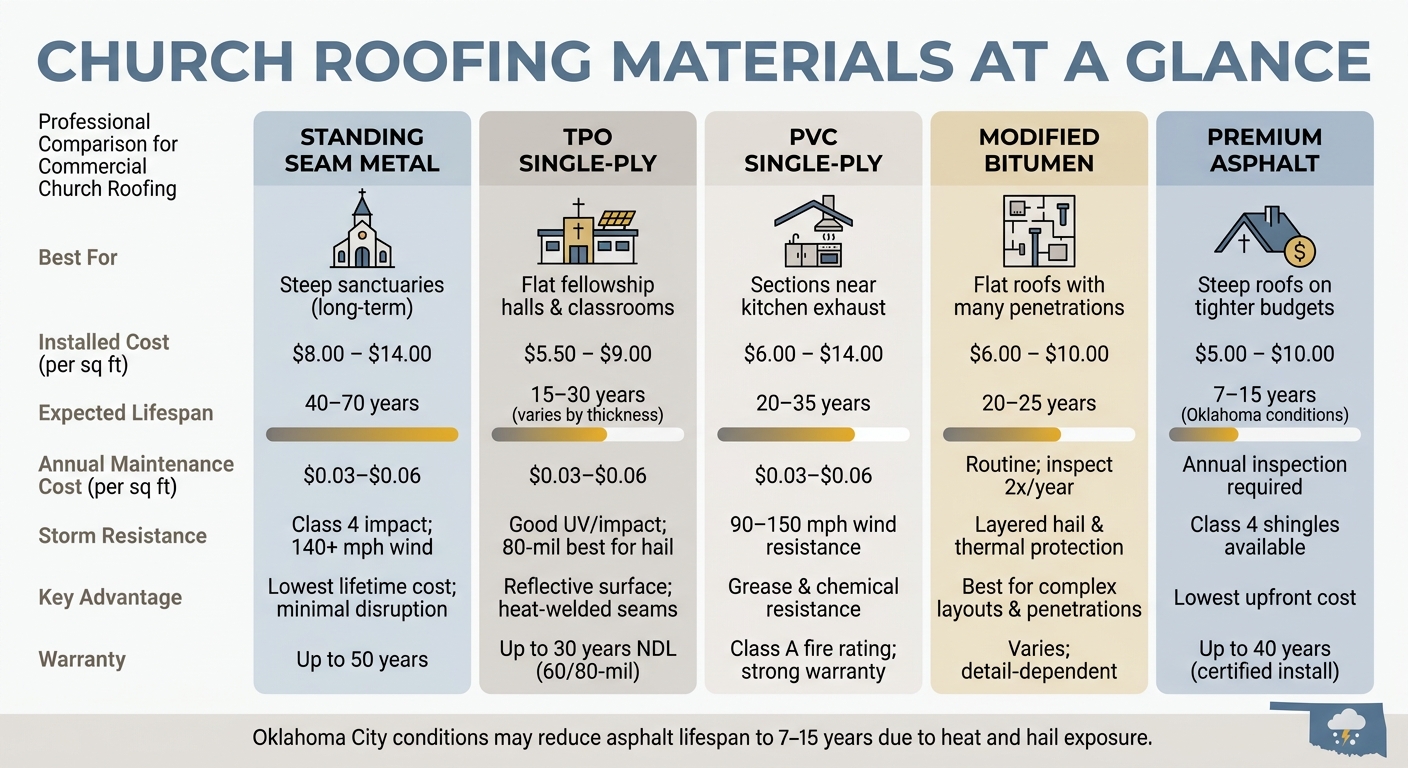
The table below shows where each system tends to fit best, and why. On many campuses, these five systems handle very different jobs.
| Material | Key Pros | Key Cons | Best Fit |
|---|---|---|---|
| Standing Seam Metal | Longest lifespan; low upkeep; strongest wind and hail performance | Highest upfront cost; requires specialized installation; may dent cosmetically | Steep-pitched sanctuaries built for long-term service |
| TPO Single-Ply | Reflective surface; lower cost; heat-welded seams reduce leak risk | Shorter life than metal; more puncture-prone than multi-ply systems | Flat fellowship halls, classrooms, and modern additions |
| PVC Single-Ply | Strong grease and chemical resistance; durable seams | Costs more than TPO; best reserved for kitchen-exhaust areas | Best for roof sections near kitchen exhaust |
| Modified Bitumen | Multi-ply strength; handles penetrations and foot traffic well | Absorbs more heat; sits in the middle on cost | Flat roofs with many penetrations, HVAC curbs, or irregular shapes |
| Premium Asphalt | Lower upfront cost; impact-resistant options; easy repairs | Shorter service life than metal | Steep-slope sanctuaries on lower budgets |
In our experience, standing seam metal is the long-game pick for steep sanctuaries. TPO and modified bitumen usually make more sense on flat sections. PVC earns its keep near kitchen exhaust, where grease can beat up other systems. Premium asphalt gives churches a lower-cost path on steep roofs, especially when the budget is tight.
From there, the last call comes down to the roof shape, how hard Oklahoma storms hit that site, and how long the church plans to keep the building.
Conclusion
Choosing a church roof is a stewardship call. We look at slope, budget, storm exposure, and how many years the building needs to serve your church well.
The right pick comes down to roof type, weather exposure, and how long the church plans to keep the building. For steep sanctuaries built for long-term use, standing seam metal gives the longest service life.
For flat fellowship halls and education wings, TPO is the top low-slope option. Modified bitumen works well on flat areas with a lot of detail. PVC is a smart fit near kitchen exhaust. Premium asphalt makes sense for steep roofs when budget matters.
We need to match the system to the roof, not force the roof to fit the system.
A qualified local contractor should check impact ratings, deal with tricky transitions between roof planes, and back the job with manufacturer-certified warranties.
If your church is weighing a replacement, we offer free roof inspections across the Oklahoma City metro. Call (405) 235-6000 to get started.
FAQs
How do we choose the right roof for each church building?
Start with a section-by-section roof inspection. On church campuses, it is common for different buildings to have different roof systems. We look at each area based on its shape, age, use, and material compatibility.
From there, we match the roof system to the building’s function. We pay close attention to transitions, drains, and HVAC curbs, because that is where many roof problems begin.
Then we prioritize repairs, coatings, or replacement using a photo-supported report that fits your church’s budget and calendar.
Is metal roofing worth the higher upfront cost for a church?
Yes. In our experience, metal roofing is often worth the higher upfront cost for churches.
We’ve seen it last 40 to 60 years or more, with very little upkeep along the way. In many cases, we can recoat it instead of replacing it, which can save a church a lot of money down the road.
It also holds up well against Oklahoma’s high winds and hail, which matters here more than most places. On top of that, metal roofing can help cut cooling costs over time because of its energy-saving performance.
What roofing system works best near a church kitchen?
If your church has a commercial kitchen, PVC is the roofing system we recommend for any roof area exposed to kitchen exhaust.
We install TPO on plenty of flat and low-slope church roofs across Oklahoma, and it is a solid option for general use. But when grease-laden exhaust hits the roof surface, PVC is the better choice for that section.